

Mathematics
Mathematics
SPACE (School-Parent Acing Children’s Experiences)
The school provides every student in Primary 1 to Primary 4 the opportunity to appreciate and enjoy Mathematics through the SPACE (School-Parent Acing Children’s Experiences) Programme. SPACE is an innovative programme that allows for greater integration of learning and teaching across disciplines in fun and creative ways, making mathematical concepts more meaningful and engaging for young learners. As part of this initiative, every Primary 1 to Primary 4 student receives a Home Kit that they can bring home to carry out hands-on activities with their parents or siblings. Through these shared experiences, the school hopes that the close interaction between parent and child in the learning process will foster positive attitudes towards the learning of Mathematics. We also hope to encourage students to explore and discover new ideas, and strengthen their confidence and curiosity in the learning of the subject.
STEMS (Striving Towards Excellence in Mathematical Skills)
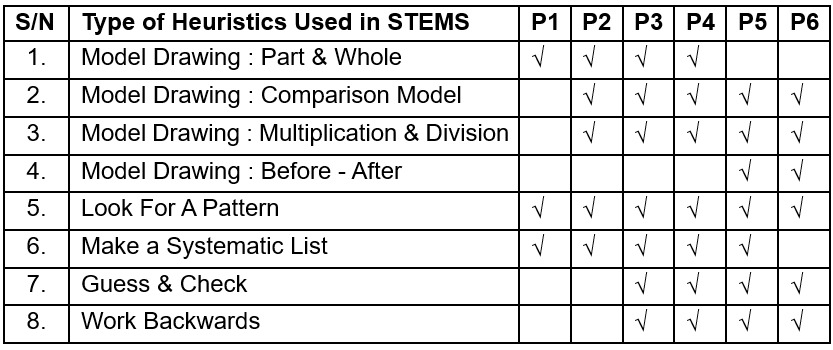
All students from Primary 1 to Primary 6 will be taught the different heuristics for problem-solving using the heuristic booklet – STEMS (Striving Towards Excellence in Mathematical Skills) which is designed by our own team of Mathematics teachers. Primary 1 & Primary 2 students will learn the basic skills in model drawing using the part-whole and simple comparison models. The learning of this skill will then spiral upwards to Primary 3 and Primary 4 where students will learn the comparison model and in Primary 5 and Primary 6, advanced model drawing skills will be taught.
By the end of the sixth year, the department hopes that all students are competent in the application of model drawing and heuristics for problem-solving.
Daily Problem Sums (DPS)
The central focus of the mathematics curriculum is the development of mathematical problem-solving competency. Students learn to apply their learning of Mathematics concepts and extend this understanding to solving problems in a variety of contexts. In this programme, Primary 1 to Primary 6 students are exposed to different types of problem sums on a regular basis in the classroom, ensuring that they gradually build confidence, flexibility and resilience in tackling both routine and non-routine questions. This continual exposure creates opportunities for students to develop key competencies that are important in the 21st century, in particular, Critical, Adaptive and Inventive Thinking. These competencies equip students not only for academic success but also for real-world problem-solving beyond the classroom.
Mobile Learning (P1 to 4)
This Mathematics programme is designed to create opportunities for Primary 1 to Primary 4 students to think critically, reason logically and communicate effectively using mathematics. It enables them to apply their learning with confidence in a variety of authentic contexts in the school environment. Students work collaboratively in groups to discuss ideas, justify solutions and learn from one another, strengthening both their conceptual understanding and interpersonal skills. The use of ICT tools in the learning of mathematics further enhances students’ engagement in the learning of Mathematics. These approaches help to foster interest in Mathematics by showing students the relevance and joy of mathematical thinking in daily life.
Mathematical Olympiad Training Programme
As part of the school’s enrichment programme, selected Primary 4 to Primary 6 students are offered the Mathematical Olympiad Training Programme. It is designed to stretch and extend their mathematical abilities beyond the standard curriculum. The objectives of this programme are to develop higher-order problem-solving skills and stimulate creative and critical thinking in Mathematics. This will enable students to approach complex tasks with flexibility. Through exposure to challenging and non-routine questions, students gain deeper insights into advanced problem-solving strategies and learn to analyse problems from multiple perspectives. The programme also aims to equip students with greater confidence in solving non-routine questions. This will help them to persevere through difficult tasks and build resilience as independent learners.